Quick Answer
ACH payment processing typically costs $0.25 to $1.50 per transaction with flat-fee pricing, or 0.5% to 1.5% with percentage-based pricing. That is 50-90% less than credit card processing for most businesses. The best deals use flat per-transaction fees with no monthly minimums.
If you process B2B invoices, recurring billing, or high-ticket transactions, ACH should be part of your payment stack. Here is exactly what it costs, how the fee structures work, and where the hidden charges live.
How ACH Fees Work
ACH (Automated Clearing House) moves money directly between bank accounts through the Federal Reserve network. Because it bypasses Visa, Mastercard, and the interchange system entirely, the cost structure is fundamentally different from card processing.
There are two main pricing models:
Flat fee per transaction
You pay a fixed dollar amount per ACH transaction regardless of the payment size. This is the most common and usually the best model for businesses.
- Typical range: $0.25 to $1.50 per transaction
- Best for: any business where the average payment is above $50
- Why it wins: a $5,000 B2B invoice costs the same $0.50 to process as a $50 subscription payment
Percentage of transaction
You pay a percentage of each payment amount, similar to credit card processing but at a much lower rate.
- Typical range: 0.5% to 1.5%
- Best for: businesses with very small average transactions (under $25)
- When it loses: on a $2,000 invoice at 1%, you pay $20 -- far more than a $0.50 flat fee
Most businesses should choose flat-fee pricing. The math almost always favors it unless your average transaction is below $25.
ACH vs Credit Card Fees: The Real Comparison
The savings from ACH are not marginal -- they are dramatic, especially at scale.
| Transaction Amount | Credit Card Fee (3%) | ACH Fee ($0.50 flat) | You Save |
|---|---|---|---|
| $100 | $3.00 | $0.50 | **$2.50 (83%)** |
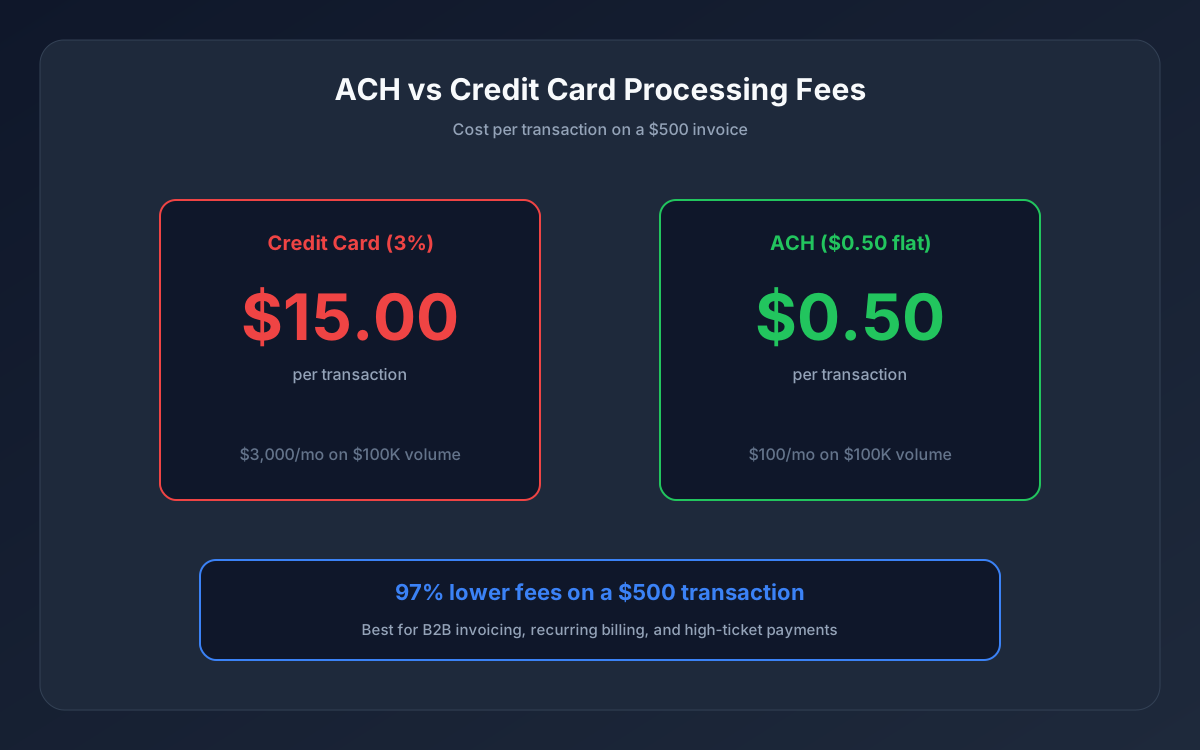
| $500 | $15.00 | $0.50 | **$14.50 (97%)** |
| $1,000 | $30.00 | $0.50 | **$29.50 (98%)** |
| $5,000 | $150.00 | $0.50 | **$149.50 (99%)** |
The higher your average transaction, the more ACH saves. This is why B2B companies, property managers, and professional services firms use ACH as their primary payment rail.
For a business processing $100,000/month in B2B invoices:
- Credit card at 3%: $3,000/month in processing fees ($36,000/year)
- ACH at $0.50/transaction (200 invoices): $100/month ($1,200/year)
- Annual savings: $34,800
For a detailed comparison of credit card pricing models, see our interchange-plus pricing guide. If you want to eliminate card fees entirely for in-person transactions, see our cash discount program.
The Full Fee Breakdown: What to Watch For
Beyond the per-transaction fee, ACH providers may charge additional fees. Here is what a complete ACH fee schedule looks like:
| Fee Type | Typical Range | Notes |
|---|---|---|
| Per-transaction fee | $0.25-$1.50 | The core cost; should be flat for most businesses |
| Monthly fee | $0-$25 | Some providers charge a platform or gateway fee |
| ACH return fee | $2-$5 | Charged when a payment bounces (insufficient funds, closed account) |
| Batch fee | $0-$0.25 | Fee per batch of transactions submitted (some providers, not all) |
| Setup fee | $0-$100 | One-time; many providers waive this |
| Monthly minimum | $0-$25 | If your fees do not reach this amount, you pay the difference |
ACH return fees are the hidden cost most businesses overlook. If a customer's payment bounces because of insufficient funds, you pay a return fee ($2-5) on top of not getting paid. High return rates also increase your risk profile with your processor.
To minimize returns: verify bank accounts before the first debit, send payment reminders before recurring charges, and monitor your return rate monthly.
Which Businesses Benefit Most from ACH
ACH is not a replacement for credit cards -- it is a complement. The right strategy is offering both and steering appropriate transactions to ACH.
Best fit for ACH:
- B2B invoicing -- Vendor payments, wholesale orders, and professional services where $500+ invoices are common. See our B2B merchant services guide.
- Recurring billing -- Gym memberships, SaaS subscriptions, rent, insurance premiums. Low per-transaction cost makes monthly charges economical.
- High-ticket purchases -- Anything over $200 where the percentage-based card fee becomes painful.
- Property management -- Rent collection via ACH is standard and dramatically cheaper than card processing.
- **High-risk merchants** -- ACH bypasses card networks, which can be advantageous for businesses with elevated card processing rates. See our high-risk eCheck processing guide.
Keep credit cards for:
- In-person retail transactions
- Small purchases under $25
- Customers who prefer cards (convenience)
- Situations where instant authorization matters
How to Get the Lowest ACH Processing Rates
1. Choose flat-fee pricing -- unless your average transaction is under $25 2. Negotiate based on volume -- providers often reduce per-transaction fees for businesses processing 500+ ACH payments per month 3. Avoid percentage-based pricing on high-ticket transactions -- the math never works in your favor 4. Ask about return fees upfront -- these add up quickly with even a 2-3% return rate 5. Bundle with your card processing -- processors like Unison offer ACH alongside card processing, often at better rates than standalone ACH providers 6. Skip providers with monthly minimums -- if your ACH volume is inconsistent, minimums eat into your savings
Same-Day ACH vs Standard ACH
Standard ACH settlement takes 2-3 business days. Same-day ACH is available for an additional fee (typically $0.50-$2.00 extra per transaction).
When same-day ACH makes sense: urgent vendor payments, payroll, time-sensitive B2B settlements.
When standard ACH is fine: recurring billing, subscription payments, non-urgent invoices. The 2-3 day wait is acceptable for most use cases.
Getting Started with ACH
Adding ACH to your payment setup is straightforward:
1. Talk to your processor -- if you already have a merchant account, ACH can often be added without a separate application 2. Set up customer authorization -- you need a signed ACH mandate before debiting customer accounts (your processor provides templates) 3. Integrate with your invoicing or billing system -- most payment gateways support ACH alongside card payments 4. Test with a small batch -- verify the flow works before processing your full volume
Unison provides ACH payment processing with flat per-transaction pricing, no monthly minimums, and integration with your existing payment gateway. **Contact us** for a custom ACH pricing quote.