Quick Answer
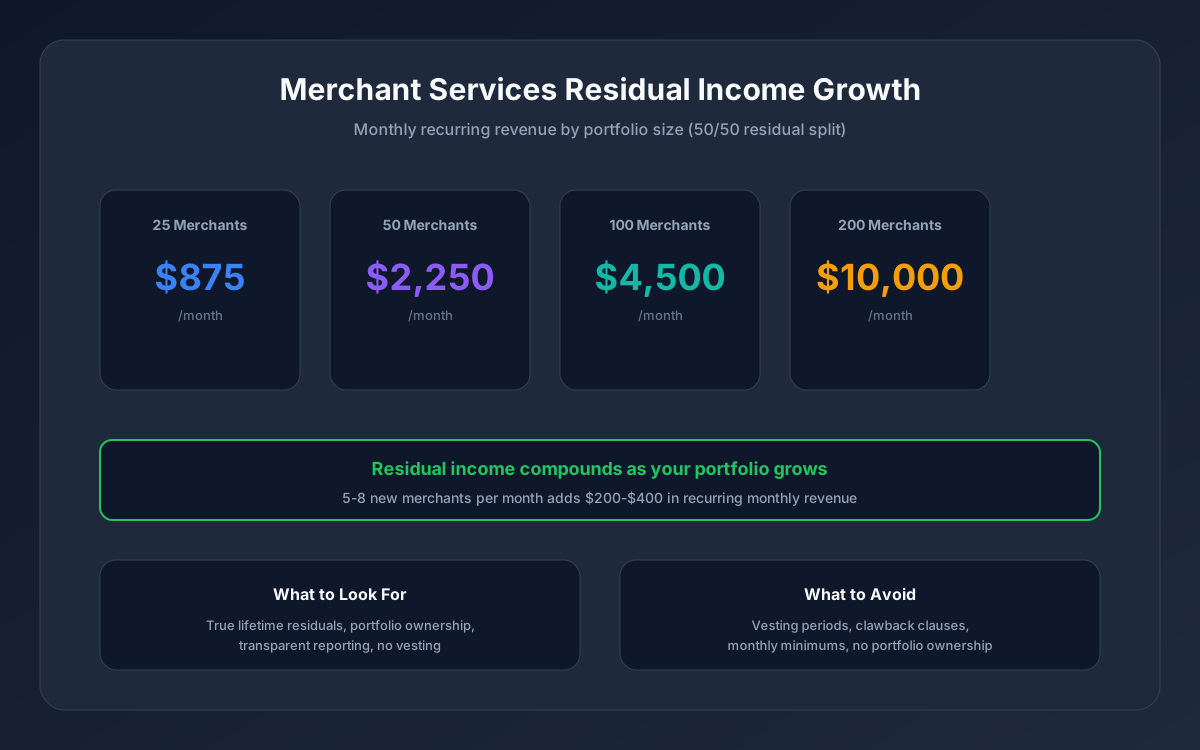
Merchant services residual income is recurring commission earned from the processing volume of merchants you have signed. Every card transaction generates revenue for the processor, and a portion of that revenue is paid to the agent or ISO who brought the merchant. This income continues as long as the merchant keeps processing -- making it one of the few truly recurring income streams in sales.
An agent with 100 active merchants can realistically earn $3,000 to $8,000+ per month in residual income, depending on merchant volume and the residual split with the processor.
How Residual Income Works
The economics are straightforward. When a merchant processes a credit card transaction, the processor earns a markup over interchange (the wholesale cost of processing). A portion of that markup is shared with the agent who signed the merchant.
Example:
- Merchant processes $30,000/month in credit card sales
- Processor charges interchange + 0.30% markup
- Processing revenue to processor: ~$90/month
- Agent's residual split (50%): $45/month from this one merchant
That $45/month continues every month the merchant processes. If the merchant grows to $50,000/month, the residual grows proportionally to ~$75/month. Multiply across dozens or hundreds of merchants, and the income compounds.
This is why experienced agents call residual income "the closest thing to a pension in sales." Once you build a portfolio, it generates income month after month.
The Math: Building a Portfolio
| Portfolio Size | Avg Merchant Volume | Monthly Residual per Merchant | Total Monthly Residual |
|---|---|---|---|
| 25 merchants | $25,000 | $35 | **$875** |
| 50 merchants | $30,000 | $45 | **$2,250** |
| 100 merchants | $30,000 | $45 | **$4,500** |
| 200 merchants | $35,000 | $50 | **$10,000** |
| 500 merchants | $40,000 | $55 | **$27,500** |
These numbers assume a 50/50 residual split and interchange-plus pricing with a reasonable markup. Actual residuals vary based on the processor's buy rate, your negotiated split, and merchant volume.
The compounding effect is what makes this model powerful. An agent who signs 5-8 new merchants per month adds $200-400 in new monthly residual each month. After two years, the cumulative portfolio generates significant passive income even during months with no new sales.
What "Lifetime Residuals" Actually Means
Many agent programs advertise "lifetime residuals." This should mean: you earn commission on a merchant for as long as they process transactions, regardless of whether you continue actively selling.
What to verify before signing:
- No vesting period -- some programs require 12-24 months of active selling before residuals vest. If you leave before vesting, you lose everything.
- No clawback on merchant attrition -- if a merchant leaves, you lose that merchant's residual. But some programs claw back past residuals if your portfolio drops below a threshold.
- Portfolio ownership -- if you leave the program, do you retain ownership of your merchant relationships? Can you move your portfolio to another processor?
- No monthly minimums -- some programs require you to sign X new merchants per month to keep your residuals active.
True lifetime residuals with portfolio ownership is the gold standard. Anything less should be negotiated or avoided.
Types of Agent Programs
W-2 employee (captive agent)
You work directly for a processor or ISO as an employee. Salary plus bonus, sometimes small residuals. You do not own your portfolio.
Pros: stable base income, training, benefits Cons: low residual splits (often 10-30%), no portfolio ownership, limited to one processor's products
1099 independent agent
You sell for one or more processors as an independent contractor. Higher residual splits, more flexibility, but no base salary.
Pros: 50-70% residual splits, flexibility, can represent multiple processors Cons: no base income, self-employed taxes, must generate your own leads
ISO (Independent Sales Organization)
You register as an ISO with card networks and recruit your own sub-agents. Highest revenue potential but requires more infrastructure.
Pros: highest residual splits (70-80%+), full portfolio ownership, ability to build a team Cons: registration costs, compliance requirements, operational overhead
For managing an ISO portfolio efficiently, see our guide on CRM for merchant payment management.
What to Look for in an Agent Program
Revenue transparency
You should see exactly how your residuals are calculated. The processor's statement should show interchange cost, markup, and your split -- line by line. If a program only shows you a lump-sum residual number without the underlying math, that is a red flag.
Competitive buy rates
Your buy rate is the wholesale cost the processor charges you. The difference between your buy rate and what the merchant pays is your revenue. Lower buy rates mean more room for competitive merchant pricing while maintaining healthy residuals.
Back-office support
Merchant onboarding, underwriting, equipment deployment, and customer service should be handled or supported by the processor. If you are expected to manage all back-office operations yourself, the residual split should reflect that.
Technology and reporting
A modern agent program provides a portal or CRM integration where you can track your portfolio, monitor merchant volume, view residual statements, and manage merchant relationships. Ask about real-time reporting vs monthly statements.
Product breadth
The more products you can offer merchants, the more revenue per merchant. Look for programs that include credit card processing, ACH, POS hardware, cash discount programs, consumer financing, and chargeback protection.
Common Mistakes New Agents Make
1. Chasing upfront bonuses over residuals -- a $500 upfront bonus disappears. A $45/month residual pays $540/year and keeps growing. 2. Ignoring attrition -- if you sign 10 merchants per month but lose 5, your portfolio grows slowly. Merchant retention matters as much as new sales. 3. Not reading the contract -- vesting schedules, clawback provisions, and non-compete clauses can eliminate your income overnight. 4. Selling on price alone -- merchants who switch for the cheapest rate will switch again when someone offers cheaper. Sell on service, technology, and stability. 5. Neglecting existing merchants -- a quick check-in every quarter prevents attrition and generates referrals.
The Bottom Line
Merchant services residual income is one of the most predictable recurring revenue models available to sales professionals. The key is choosing the right program (true lifetime residuals, portfolio ownership, transparent reporting) and building a portfolio with discipline.
The income is real, but it is not instant. Most successful agents spend 12-18 months building before their residual income exceeds what they could earn in a traditional sales role. After that, the compounding effect makes it increasingly difficult to walk away from.
Unison offers a partner program with competitive residual splits, full portfolio transparency, and a product suite that gives agents everything they need to serve merchants across industries. **Contact us** to learn about agent and ISO partnership opportunities.