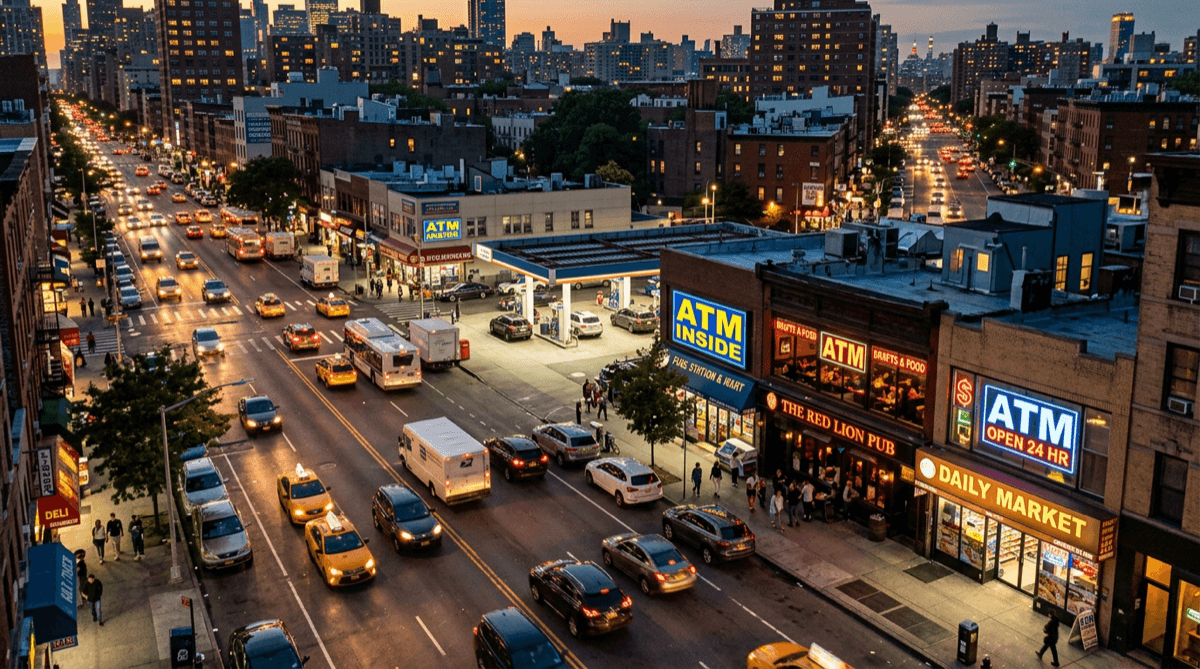
The ATM business generates $2.3 billion in surcharge revenue annually in the United States alone. Over 470,000 non-bank ATMs are deployed across the country — in convenience stores, gas stations, bars, dispensaries, hotels, and everywhere else people need cash. Despite the rise of digital payments, cash remains essential for millions of transactions every day, and ATM usage at non-bank locations has held steady.
If you are looking for a cash-generating business with predictable revenue, low overhead, and genuine scalability, the ATM business deserves your attention. This guide covers the real economics, the best locations, and how to get started — whether you want a single machine or a full route.
How the ATM Business Model Works
The economics are simple. You place an ATM in a location. Customers withdraw cash and pay a surcharge — typically $2.50–$3.50 per transaction. You keep all or most of that surcharge as revenue.
Your primary costs are the machine itself (if you buy), cash loading, basic maintenance, and transaction processing. The difference between revenue and costs is your profit.
Revenue per machine (conservative):
- Average surcharge: $3.00
- Average transactions/month: 250
- Monthly gross revenue: $750
- Monthly costs (processing, maintenance, cash service): $300–$400
- Monthly net profit: $350–$450 per machine
Scale to 5 machines and you are earning $1,750–$2,250/month. Scale to 20 and you are in the $7,000–$9,000/month range. ATM operators with 50+ machines regularly generate six-figure annual income.
Startup Costs: What You Actually Need
Option A — Buy machines, place them yourself (see our ATM machines for sale guide for model comparisons and real pricing):
- ATM machine: $2,500–$5,000 each
- Cash float per machine: $2,000–$5,000
- Processing setup: $0–$200
- Installation: $200–$500 per location
- Total per machine: $5,000–$10,000
Option B — Partner with a placement company:
If you have locations but not capital, a placement partner like Unison Payment Solutions provides machines at no cost, handles installation, loads cash, and manages operations. You receive a share of each transaction's surcharge. This is the fastest way to start earning with zero capital risk.
The 10 Best Places to Put ATM Machines (Ranked by Transaction Volume)
Location is everything in the ATM business. A well-placed machine generates 500+ transactions monthly. A poorly placed one generates 50. Here are the top locations, ranked:
1. Bars and Nightclubs (400–800+ transactions/month)
Cash is king in nightlife. Tips for bartenders, cover charges, pool tables, jukeboxes, and impulsive spending all drive ATM usage. Friday and Saturday nights generate 40–60% of weekly volume.
2. Cannabis Dispensaries (300–600+ transactions/month)
Dispensaries cannot accept credit cards for THC products due to federal banking restrictions. Every customer needs cash. Dispensary ATMs consistently rank among the highest-volume non-bank ATM locations in legal markets. Read our dispensary ATM guide for a deep dive into costs, state-by-state regulations, and how cashless ATMs work.
3. Convenience Stores and Bodegas (200–500 transactions/month)
The backbone of the ATM business. High foot traffic, extended hours, and cash-preferring customers. Urban convenience stores skew toward the higher end; suburban locations are more moderate.
4. Gas Stations and Truck Stops (250–500 transactions/month)
Steady, predictable traffic. Travelers frequently need cash. Truck stops in particular serve a cash-heavy customer base with long operating hours.
5. Laundromats (150–350 transactions/month)
Machines require cash or coins. ATM demand is literally built into the business model. Bonus: laundromat customers often have extended wait times, increasing the chance of a purchase at nearby businesses.
6. Hotels and Motels (100–300 transactions/month)
Guests need cash for tipping housekeeping, valet, bellhops, and room service. Tourist-area hotels skew higher. Budget motels often serve cash-preferring travelers.
7. Event Venues (seasonal, 200–2,000+ on event days)
Concerts, fairs, sporting events, and festivals drive massive ATM transaction spikes. Revenue is seasonal but can be extremely high per event.
8. Strip Clubs and Adult Entertainment (400–1,000+ transactions/month)
Cash-only tipping is standard. Transaction volumes rival nightclub numbers. Many adult entertainment venues report ATMs as their highest-revenue amenity.
9. Bowling Alleys and Arcades (100–300 transactions/month)
Games, vending machines, and food counters drive cash demand. Family entertainment centers with multiple attractions perform especially well.
10. Check Cashing Locations (200–500 transactions/month)
Customers who cash checks frequently need ATM access for other accounts. These locations serve a heavily cash-dependent demographic.
Locations that sound good but often underperform: office buildings (employees use direct deposit and cards), upscale restaurants (card-dominant), residential lobbies (low traffic), and rural general stores (insufficient volume).
ATM Route Business vs. Single Location
Single location: You have a business and want an ATM in it. Free placement is usually the best option — zero capital, zero management, passive income.
Route business: You acquire multiple ATM locations across a geographic area. You own or lease the machines, negotiate placement agreements with location owners (offering them a small revenue share), and manage the route. This is a real business that requires capital, time, and operational management.
Route business economics (10 machines):
- Investment: $50,000–$100,000 (machines + cash floats)
- Monthly gross revenue: $7,500 (10 machines × 250 transactions × $3.00)
- Monthly costs: $3,500–$4,500 (processing, cash service, maintenance, location shares)
- Monthly net profit: $3,000–$4,000
- Annual net: $36,000–$48,000
Scale to 25 machines and you are earning $75,000–$120,000/year. Scale to 50 and you are approaching $150,000–$240,000.
The turnkey ATM business model works because the unit economics are predictable. Each machine is its own profit center. If a location underperforms, you relocate the machine. If it outperforms, you add a second unit.
Getting Started: Your First ATM
If you want passive income from your own business: 1. Apply for free ATM placement through Unison Payment Solutions 2. We evaluate your location, install the ATM, and handle everything 3. You earn revenue share from day one
If you want to build an ATM route business: 1. Research locations in your area using the ranking above 2. Secure location agreements (approach business owners, offer $50–$100/month or revenue share) 3. Purchase or lease ATMs 4. Set up processing accounts 5. Arrange cash loading (self-load or armored service) 6. Install machines and begin operations
If you want the route but not the capital risk: Partner with Unison. We can supply machines for your route locations through our free placement program, handle cash loading and maintenance, and share revenue with both you and the location owner. You focus on securing locations; we handle operations.
Is the ATM Business Still Profitable in 2026?
Yes. Despite mobile payments and declining bank ATM usage, non-bank ATM transactions remain stable because they serve a different market. People who use convenience store ATMs are not choosing between Apple Pay and cash — they need cash specifically for rent, tips, entertainment, dispensary purchases, peer-to-peer payments, or simply because they prefer it.
The Bureau of Labor Statistics reports that approximately 30% of U.S. transactions under $25 are still cash. The Federal Reserve's data shows cash in circulation continues to grow year over year. As long as cash circulates, ATMs generate revenue.
Contact Unison Payment Solutions → to discuss ATM placement for your business or your route. Call (925) 290-6003.