What Is 4% Dual Pricing?
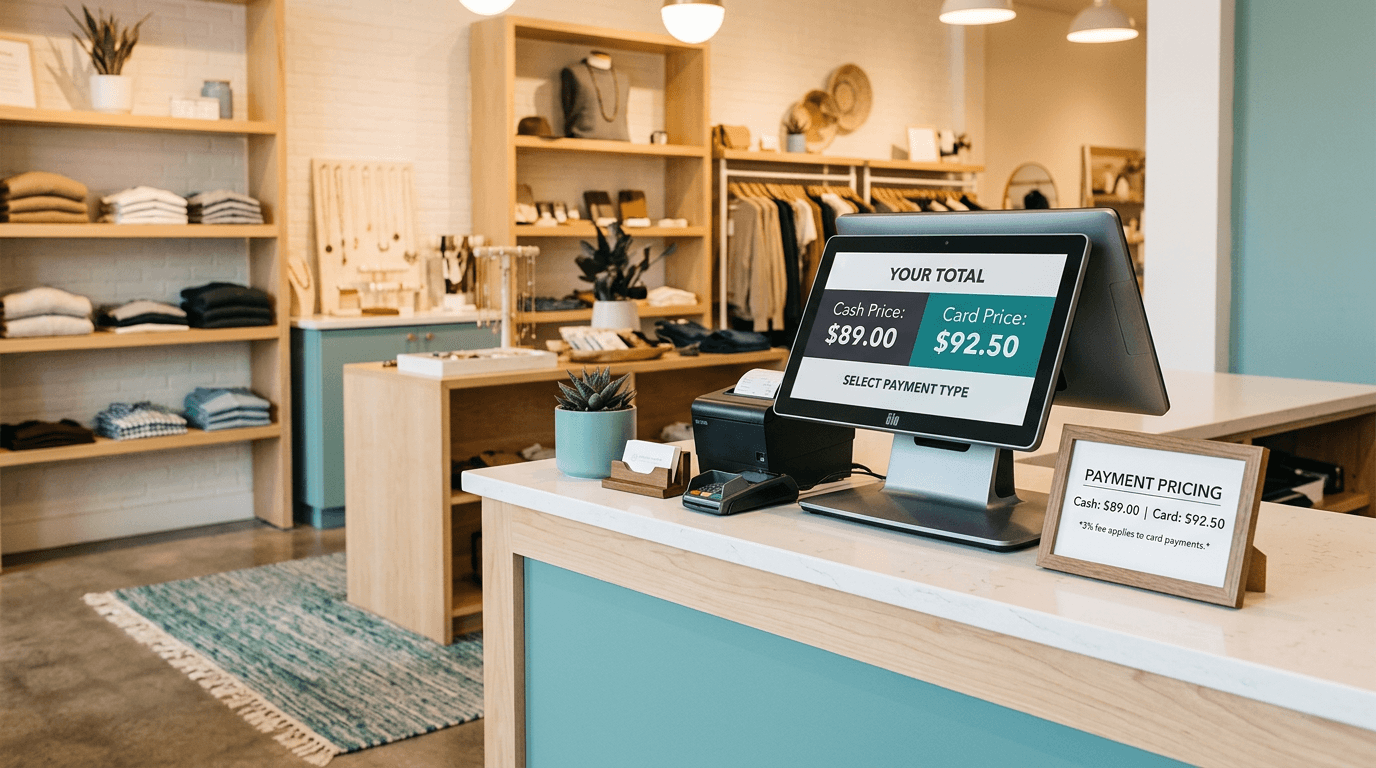
Dual pricing is a pricing model where your business displays two prices for every product or service: a cash price and a card price. The card price includes a small service fee (typically 4%) that covers your processing costs. Customers who pay with cash, check, or debit get the lower price.
The result: your effective credit card processing cost drops to nearly zero. The customer sees both prices clearly before paying and chooses their preferred method.
This is different from surcharging, which adds a fee on top of a single listed price. Dual pricing is structured as a discount for cash, which is legal in all 50 states and compliant with Visa and Mastercard rules when implemented correctly.
Who Qualifies for Dual Pricing?
Eligible: Storefront and Invoicing Businesses
Dual pricing is available for businesses that accept payments in person or through invoicing / MOTO (mail order / telephone order). This includes:
- Restaurants, cafes, and bars — table-side or counter terminals
- Retail stores — clothing, convenience, specialty shops
- Salons, barbershops, and spas — service-based with card-present checkout
- Auto repair and dealerships — invoiced or counter payments
- Contractors and home services — field invoicing, on-site payments
- Professional services — accounting, legal, consulting
- Gyms and fitness studios — front-desk or kiosk checkout
- Medical and dental offices — front-office copay collection
The common thread: the customer is physically present or you are sending an invoice where dual pricing can be disclosed before the transaction.
NOT Eligible: eCommerce and Online-Only Businesses
If your primary sales channel is an online checkout (Shopify, WooCommerce, BigCommerce, custom cart), you cannot use dual pricing. Card network rules prohibit dual pricing for card-not-present transactions processed through a payment gateway.
This means:
- Online-only stores selling any product category → not eligible
- Subscription boxes processed online → not eligible
- SaaS or digital product sales → not eligible
- Marketplace sellers (Amazon, eBay, Etsy) → not eligible
If you sell online, your best option is Interchange + Low Risk (for standard products) or Interchange + High Risk (for regulated or high-chargeback categories).
Mixed Businesses (Online + In-Person)
If you sell both in-store and online, you can use dual pricing for your in-person transactions while running your online transactions through a standard interchange account. Unison can configure this under a single merchant relationship in most cases. The key requirement: dual pricing only applies to the card-present or invoice side, never to the eCommerce gateway.
How Dual Pricing Works in Practice
Setup
1. Apply through Unison's 4% Dual Pricing program 2. Receive pre-configured hardware — Clover, PAX, or Dejavoo terminals with dual pricing enabled 3. Post signage — clear notices at your entrance and register explaining the two-price structure 4. Process — the terminal automatically calculates and displays both prices
What Customers See
At checkout, the terminal (or your POS) shows:
- Cash price: $100.00
- Card price: $104.00
The customer chooses. No surprise fees, no hidden charges. Receipts clearly show which price was applied.
Compliance Requirements
- Signage: Visible notice at the entrance and at every payment point
- Receipt clarity: Both prices must appear on the receipt
- No selective application: You cannot apply dual pricing only to certain customers or certain card types — it must be consistent
- Proper configuration: The terminal must be programmed to handle dual pricing through the processor, not manually added after the fact
Unison handles terminal configuration and provides compliant signage templates as part of the program setup.
Dual Pricing vs. Other Fee-Reduction Strategies
| Strategy | How It Works | eCommerce Eligible? | Legal Everywhere? |
|---|---|---|---|
| **Dual pricing (cash discount)** | Two prices displayed; card price higher | No | Yes, all 50 states |
| **Surcharging** | Single price + fee added at card payment | Yes (limited) | No — banned in some states |
| **Convenience fee** | Fee for using a non-standard payment channel | Limited | Yes, but strict rules |
| **Interchange optimization** | Lower your rate through better data and batching | Yes | Yes |
For a deeper comparison: Cash discount vs surcharge vs convenience fee.
Common Misconceptions
"Dual pricing is illegal." It is not. Cash discounting has been explicitly legal under federal law since the Dodd-Frank Act. Dual pricing structures comply with Visa and Mastercard network rules when implemented through a certified processor.
"Customers will leave." Data from Unison merchants shows that most customers adjust within the first week. Many prefer to pay cash or debit to get the lower price. The businesses that struggle are those with poor signage or surprise fees — transparency solves this.
"I can do this on my own website." You cannot. Card-not-present transactions processed through a payment gateway are not eligible for dual pricing under current card network rules. This is a point-of-sale program only.
How to Apply
If your business accepts payments in-person or through invoicing, you likely qualify for the 4% Dual Pricing program.
**Apply for 4% Dual Pricing →**
Not sure if dual pricing is the right fit? Take the 60-second quiz or call Unison at (925) 290-6003 to discuss your options. If dual pricing isn't a match, we'll route you to the best interchange program for your business.