Quick Answer
Cash discount programs let high-risk and ecommerce merchants eliminate processing fees by displaying a card price that includes the cost of processing, then offering a discount to customers who pay with cash, debit, or ACH. The approach is legal in all 50 states, works for any product category, and matters more for high-risk businesses because their baseline rates are significantly higher than standard retail.
If you process $80,000 per month through a high-risk merchant account at 5%, you are paying $4,000 per month in processing fees. That is $48,000 per year going to card networks and processors instead of your business. Cash discount can bring that number close to zero.
Why Cash Discount Matters More for High-Risk Merchants
Standard retail businesses pay roughly 2-3% in processing fees. That is the number most cash discount guides assume. But high-risk merchants -- CBD stores, supplement brands, vape shops, online gambling platforms -- typically pay 4-7% because acquiring banks charge more to offset elevated chargeback and compliance risk.
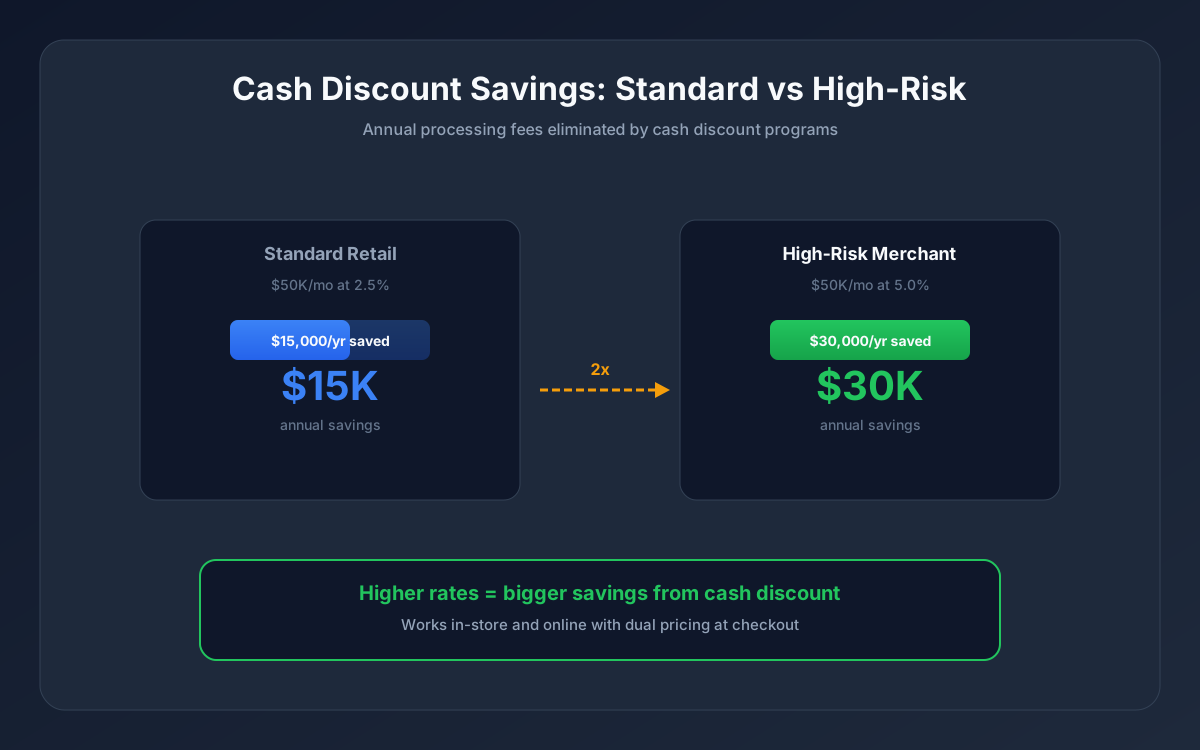
The higher your processing rate, the bigger the savings from cash discount. A standard retailer processing $50,000/month at 2.5% saves $15,000/year. A high-risk merchant at the same volume and a 5.5% rate saves $33,000/year. Same program, same effort, more than double the impact.
| Business Type | Monthly Volume | Processing Rate | Monthly Fees | Annual Savings with Cash Discount |
|---|---|---|---|---|
| Standard retail | $50,000 | 2.5% | $1,250 | **$15,000** |
| [CBD ecommerce](/industries/cannabis/cbd-merchant-account) | $50,000 | 5.0% | $2,500 | **$30,000** |
| Supplement brand | $80,000 | 4.5% | $3,600 | **$43,200** |
| Smoke shop (multi-location) | $120,000 | 5.5% | $6,600 | **$79,200** |
These are not theoretical numbers. They reflect the actual rate ranges high-risk merchants pay through properly underwritten accounts. For a detailed breakdown of how processing fees work, see our interchange-plus pricing guide.
How Cash Discount Works In-Store vs Online
In-store (card-present)
The mechanics are straightforward and well-documented. Your POS terminal displays the card price, which includes a service fee (typically 3.5-4%). Customers who pay cash see the discount applied automatically. Signage at the entrance and register explains the program. For a full walkthrough, see our cash discount program page.
Online (ecommerce dual pricing)
This is where most guides stop, and it is exactly where high-risk merchants need answers.
Online cash discount uses dual pricing at checkout. Your product pages show the card price. At checkout, the customer sees two options:
- Pay by card: the listed price (includes processing cost)
- Pay by ACH/bank transfer: a lower price (the "cash" equivalent)
The discount for ACH payment replaces the in-store cash discount. The disclosure that would be on a physical sign instead appears on the checkout page itself -- clearly stating that prices include a service fee for card payments and that non-card payments receive a discount.
**Your payment gateway handles the calculation.** When configured correctly, the gateway applies the correct pricing based on the payment method selected. No manual price changes, no separate product listings.
What replaces signage for online stores?
For ecommerce, you need:
- Checkout page disclosure -- a clear statement before the customer clicks "Pay" explaining the pricing structure
- Cart summary -- the discount amount shown as a line item when ACH/bank transfer is selected
- Confirmation email -- the receipt should reflect which price the customer paid and why
This satisfies the same disclosure requirements that in-store signage covers. For the full legal comparison between cash discount and surcharging (including state-by-state rules), see our cash discount vs surcharge vs convenience fee guide.
Which High-Risk Industries Benefit Most
Any high-risk merchant with a mix of card and non-card payment volume can benefit. But some verticals see larger gains because of their transaction patterns:
CBD and hemp ecommerce -- Online CBD stores process almost entirely by card. Adding ACH as an alternative with a cash discount incentive shifts 15-30% of transactions to a lower-cost rail. Combined with already-high processing rates (4.5-6%), the savings are substantial. See our CBD payment processing guide for the full picture.
Nutraceutical and supplement brands -- Subscription-based supplement businesses can offer ACH billing as the default for recurring orders, with a small price incentive. This reduces both processing fees and chargeback exposure (ACH disputes are handled differently than card chargebacks). Read more about nutraceutical merchant accounts.
Smoke shops and vape retailers -- Physical smoke shops with cash-heavy customer bases are ideal for in-store cash discount. Many already have a significant percentage of cash transactions. The program formalizes the pricing and eliminates fees on card transactions. For vape-specific processing, see our vape payment processing guide.
High-risk ecommerce with high average ticket -- The higher your average transaction, the more each card fee costs. A $200 average order at 5% costs $10 per transaction in processing. A cash discount program can recover that entirely.
Compliance: Same Rules, Different Implementation
Cash discount is legal in all 50 states under the Dodd-Frank Act. This does not change based on your risk classification. The product you sell does not affect whether you can offer a cash discount -- the rules apply to the payment method, not the merchandise.
The core compliance requirements are the same for high-risk and standard merchants:
1. Prices must be posted at the card rate (the higher price) 2. Cash/debit/ACH customers receive a discount (not a penalty for card users) 3. Disclosure must happen before the customer commits to the transaction 4. Receipts must show the discount when applicable
For online merchants, the disclosure moves from physical signage to checkout page copy. For a complete state-by-state breakdown of fee-related regulations (including where surcharging is banned but cash discount is allowed), see our state-by-state surcharging rules.
One important distinction: cash discount and surcharging are not the same thing. Surcharging adds a fee to card payments. Cash discount reduces the price for non-card payments. The psychological and legal difference matters. If you are unsure which approach fits your business, see our cash discount vs surcharging comparison.
How to Set It Up
In-store
1. Contact your processor -- Unison configures your terminal for dual pricing at no additional cost 2. Receive signage -- We provide compliant signage for your entrance and register 3. Staff training -- A 15-minute walkthrough so your team can explain the program to customers 4. Go live -- The terminal handles the math automatically from day one
Online (ecommerce)
1. Gateway configuration -- Your payment gateway is configured to display dual pricing at checkout 2. Add ACH as a payment option -- If you do not already offer ACH processing, this is added to your checkout flow 3. Checkout page disclosure -- We provide the exact copy to add to your checkout page 4. Test and launch -- Verify the pricing displays correctly on desktop and mobile before going live
Most merchants are fully set up within 5-7 business days. The configuration is handled by your processor -- you do not need to rebuild your checkout.
The Bottom Line
High-risk merchants lose more to processing fees than almost any other business category, and cash discount is the most direct way to stop that. Whether you run an in-store operation or an ecommerce brand, the mechanics are proven, the compliance path is clear, and the savings scale with your volume.
If you are paying 4-7% on every transaction and have not explored cash discount, the math alone is worth a conversation.
**Contact Unison** for a free processing statement analysis. We will show you the exact dollar amount you would save with a cash discount program -- no commitment, no signup required.