Quick Answer
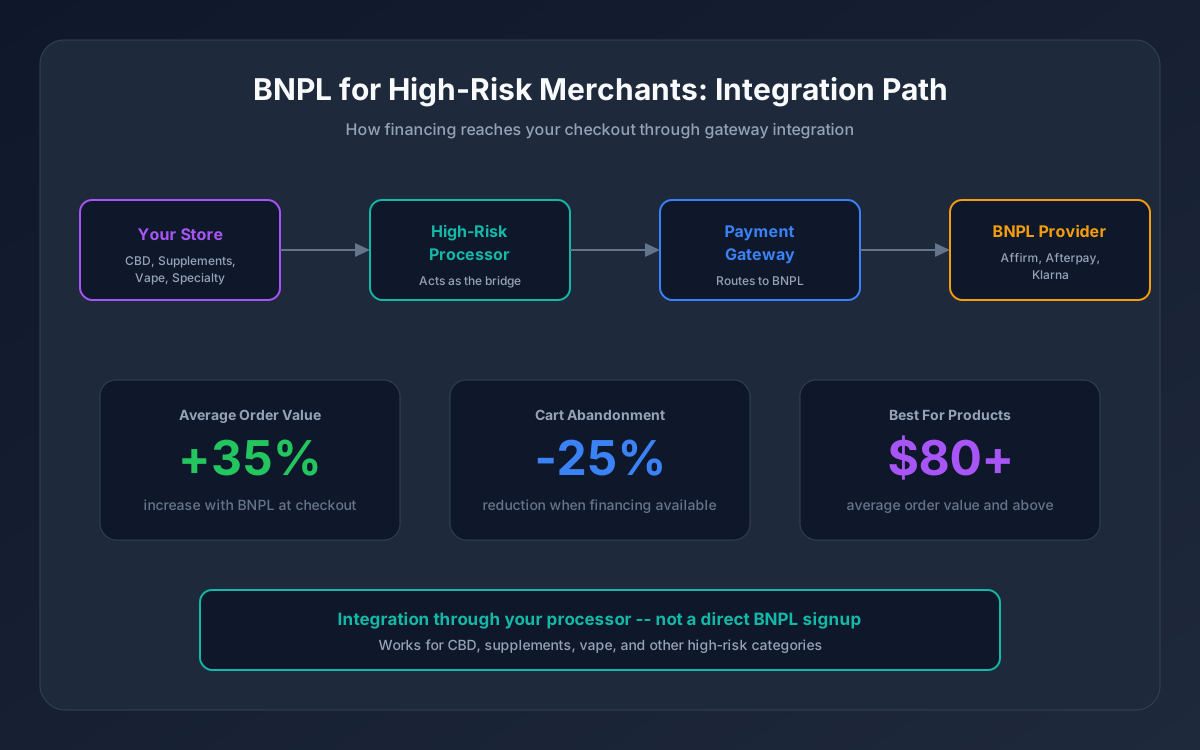
High-risk merchants can offer Buy Now Pay Later at checkout, but the path is different from standard retail. Most BNPL providers (Affirm, Afterpay, Klarna) have acceptable use policies that mirror Stripe and PayPal -- they exclude certain product categories. The workaround is integrating BNPL through your payment gateway via a processor that has relationships with financing providers willing to underwrite high-risk verticals.
The payoff is real: BNPL typically increases average order value by 30-50% and reduces cart abandonment by 20-30%. For high-risk merchants selling products with higher price points -- supplements, CBD, specialty goods -- that lift can offset both the BNPL fee and your elevated processing costs.
Why Most BNPL Providers Reject High-Risk Merchants
BNPL companies evaluate merchants the same way traditional processors do. They look at product category, chargeback rates, regulatory exposure, and refund patterns. If your business falls into a category that Stripe or PayPal would decline, most BNPL providers will decline you for the same reasons.
The specific reasons vary by provider:
- Product restrictions -- CBD, supplements with health claims, vape products, and adult content are commonly excluded from self-service BNPL signup
- Chargeback and dispute risk -- BNPL providers bear the credit risk on installment payments, so they avoid categories with elevated dispute rates
- Regulatory uncertainty -- Products in legal gray areas (state-by-state CBD rules, for example) create compliance complexity that most BNPL providers prefer to avoid
This does not mean financing is impossible. It means the direct signup path (going to affirm.com and creating an account) usually will not work. The alternative is going through a processor that already has BNPL provider relationships for high-risk categories.
How BNPL Integration Works for High-Risk Merchants
In standard retail, BNPL integration is simple: install a Shopify plugin, connect your Affirm or Afterpay account, and the financing option appears at checkout. For high-risk merchants, the integration takes a different path.
Gateway-based integration
Your high-risk payment gateway already handles the complexity of routing transactions through an acquiring bank that accepts your product category. BNPL integration layers on top of that existing setup.
The flow works like this:
1. Your processor establishes the BNPL relationship -- Because the processor already has your underwriting in place, they can facilitate the BNPL provider's review of your business 2. The BNPL option is added to your gateway checkout -- The financing choice appears alongside card and ACH at the payment step 3. Customer selects BNPL and completes approval -- The BNPL provider runs a soft credit check and presents installment options 4. You receive full payment -- The BNPL provider pays you the full order amount (minus their fee) within 1-3 business days 5. The customer pays the BNPL provider over time -- You have no involvement in collections
The key difference from standard retail: your processor acts as the bridge. You do not sign up with the BNPL provider directly. Instead, the financing option is enabled through your existing gateway relationship. This is how Unison facilitates BNPL for merchants in elevated-risk categories.
Direct integration (when available)
Some BNPL providers have expanded their acceptable use policies to include specific high-risk categories -- particularly legal, compliant CBD and supplement businesses with third-party certifications. In these cases, direct integration through a checkout plugin may work, but you should confirm with both your BNPL provider and your processor before going live to avoid account termination.
The Economics: When BNPL Makes Sense for High-Risk
BNPL is not free. Providers charge merchants between 2% and 6% per financed transaction, depending on the provider, the installment length, and your negotiated rate. For high-risk merchants already paying 4-7% in card processing fees, adding another 2-6% on top requires a clear ROI.
The math works when your average order value is high enough for the AOV lift to cover the cost.
| Average Order Value | BNPL Fee (4%) | AOV Increase (35%) | New AOV | Net Gain per Order |
|---|---|---|---|---|
| $40 | $1.60 | $14 | $54 | $12.40 |
| $80 | $3.20 | $28 | $108 | $24.80 |
| $150 | $6.00 | $52.50 | $202.50 | $46.50 |
| $300 | $12.00 | $105 | $405 | $93.00 |
For products under $50, BNPL rarely justifies the fee. The AOV lift on a $30 purchase is modest, and many BNPL providers set minimum order thresholds around $35-50 anyway.
For products above $80, BNPL almost always pays for itself. The 30-50% AOV increase on higher-ticket items creates enough margin to cover the financing fee and then some. This is why Affirm works particularly well for supplement subscription bundles, CBD wellness packages, and specialty goods.
The conversion angle
Beyond AOV, BNPL reduces cart abandonment. Industry data consistently shows a 20-30% drop in abandoned carts when financing is available at checkout. For high-risk merchants who already lose customers to payment friction (limited payment options, unfamiliar processors), adding a trusted name like Affirm or Afterpay at checkout builds confidence and removes price objections simultaneously.
Industry-Specific Angles
CBD and hemp
CBD merchants with average order values above $60 are strong candidates for BNPL. Subscription CBD bundles (3-month supply, wellness kits) are exactly the type of purchase where customers prefer installments. The challenge is finding a BNPL provider that accepts CBD -- this is where the gateway-based integration through a high-risk processor becomes essential. For CBD-specific processing, see our CBD merchant account guide.
Nutraceuticals and supplements
Supplement brands selling premium formulations ($80-200+ per order) see significant BNPL adoption. Customers who might hesitate to spend $150 upfront on a supplement stack are more willing when the cost is split into four payments of $37.50. If you run a supplement business, see our nutraceutical merchant account guide for processing setup.
Vape and specialty retail
In-store vape shops and specialty retailers can offer BNPL at the physical register through POS integration. Starter kits and hardware purchases ($100-300) are natural BNPL territory. The provider must accept your product category, which limits options but does not eliminate them.
What to Ask Your Processor
Not every high-risk processor offers BNPL integration. Before assuming your processor can help, ask these questions:
1. Which BNPL providers do you have relationships with? -- The answer should include at least one major name (Affirm, Afterpay, Klarna, or a vertical-specific provider) 2. Have you integrated BNPL for merchants in my industry? -- Ask specifically about your product category, not just "high-risk" generally 3. Does the integration go through my existing gateway or require a separate account? -- Gateway-based is preferred for simplicity and stability 4. What is the BNPL provider's fee structure for my category? -- High-risk BNPL fees can be higher than standard retail 5. Is there a minimum monthly volume requirement? -- Some BNPL provider agreements require a minimum transaction count
Unison offers consumer financing integration through Affirm, Afterpay, and Klarna for merchants across risk categories. The integration runs through our gateway partnerships, so you do not need a separate BNPL provider account. For a complete overview of BNPL options, see our Buy Now Pay Later for Merchants guide.
The Bottom Line
Consumer financing is not reserved for standard retail. High-risk merchants can offer BNPL at checkout -- the integration path is different, but the conversion and AOV benefits are the same. The key is working with a processor that has the BNPL provider relationships and can route financing through your existing high-risk gateway.
If your average order is above $80 and you are not offering financing at checkout, you are leaving revenue on the table. The customers are already used to seeing "Pay in 4" at every other store they shop at. When your checkout does not offer it, they notice.
**Contact Unison** to discuss BNPL integration for your high-risk merchant account. We will walk you through which providers work for your category and what the setup looks like.